

When you walk out onto your patio on a crisp New Jersey morning, the last thing you want to see is a shimmering turquoise oasis marred by jagged cracks, rough patches, or unsightly mineral stains. For many homeowners in our region, a swimming pool is the single largest investment in their backyard’s infrastructure. Yet, there is a common misconception that the interior finish is purely aesthetic—a “paint job” for the water. In reality, the interior lining of your gunite pool is a high-performance waterproof membrane that stands as the only barrier between thousands of gallons of chemically treated water and the structural integrity of your home’s foundation.
As we enter 2026, the demand for high-caliber pool resurfacing services has shifted from simple cosmetic touch-ups to a deep-seated focus on longevity and material science. The unique geological and atmospheric conditions of the Northeast—ranging from the dense clay soils of North Jersey to the aggressive freeze-thaw cycles that define our winters—place immense stress on masonry surfaces. When that surface begins to fail, it isn’t just an eyesore; it is a ticking clock. At EverClear Pools & Spas, we approach every project through the lens of structural preservation. This guide will dissect the technical realities of pool resurfacing, helping you understand why timely intervention is the most cost-effective way to protect your liquid asset.
1. The Anatomy of Failure: Why Pool Surfaces Degrade
To understand the necessity of pool resurfacing, one must first understand the life cycle of a submerged masonry finish. Whether your pool is finished with traditional white plaster, a quartz-enhanced mix, or a premium pebble aggregate, it is constantly subject to “leaching” and “carbonation.”
The “Hungry Water” Phenomenon
New Jersey’s municipal water sources vary wildly in mineral content. If the calcium hardness in your pool water is too low, the water becomes “aggressive.” Through a process of osmosis, the water will actually pull calcium out of the plaster finish to balance itself. Over time, this creates microscopic “voids” in the surface, leading to the sandpaper-like texture that scrapes swimmers’ feet. Once the “cream” or smooth top layer of the plaster is gone, the structural decay of the finish accelerates.
Delamination and the Hollow Spot Risk
In our local climate, the ground is never truly still. The expansion and contraction of the soil during the winter can cause “delamination”—a condition where the interior finish physically separates from the gunite shell. During professional pool resurfacing services, we often find “hollow spots” that are undetectable to the naked eye but resonate with a dull thud when tapped with a specialized tool. If left unaddressed, these hollows can fill with water, freeze, and eventually cause large chunks of the finish to pop off, exposing the raw concrete and rebar underneath.
2. Technical Milestones: The Process of Professional Restoration
A common question homeowners ask is whether they can simply “patch” a failing pool. In the world of high-end property maintenance, a patch is a temporary bandage on a systemic problem. A full pool resurfacing is a multi-stage engineering feat.
Phase I: The Hydrostatic Drain and Forensic Audit
Draining a pool in New Jersey is a high-risk maneuver if not handled by experts. In areas with high water tables, an empty pool can actually “float” or pop out of the ground due to hydrostatic pressure. We utilize specialized relief valves and pump systems to ensure the shell remains stable. Once empty, we perform a forensic audit of the gunite, looking for “weeping” cracks or signs of rebar oxidation.
Phase II: The Chip-Out and Bond-Kote Application
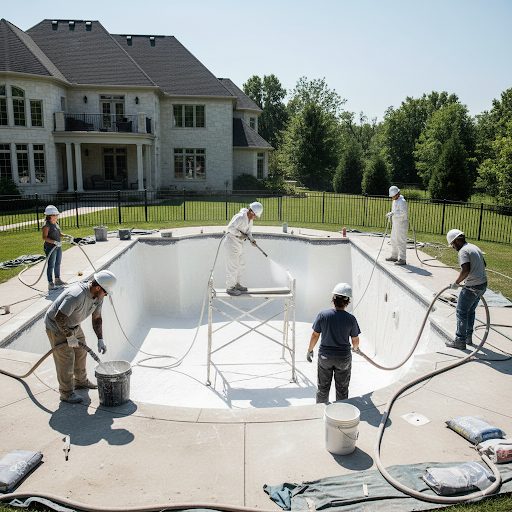
The most critical step in pool resurfacing is the preparation of the substrate. We don’t just “rough up” the surface; we perform a technical “chip-out,” removing old material around the tile line, return jets, and light niches. We then apply a high-performance “Bond-Kote”—a specialized adhesive made of fortified resins and sands. This creates a textured “mechanical lock” that ensures the new finish becomes a permanent part of the pool’s structure.
Phase III: Pneumatic Application and Hand-Troweling
In 2026, the industry standard involves the pneumatic application of material, followed by hours of meticulous hand-troweling. This isn’t just about making it smooth; it’s about “packing” the material to eliminate air pockets and ensure maximum density. A denser finish is a more waterproof finish.
3. Comparing Interior Finishes: 2026 Material Science
Selecting a finish is the most significant decision you will make during the resurfacing process. Each material offers a different balance of comfort, durability, and chemical resistance.
Standard White Plaster (Marcite)
Traditional plaster is a mix of white portland cement and marble dust. While it provides a classic look and the lowest upfront cost, it is also the most susceptible to chemical fluctuations. In New Jersey, you can expect 8 to 12 years of life from a well-maintained plaster finish.
Quartz-Enhanced Plaster
By blending crushed quartz—one of the hardest minerals on Earth—with portland cement, we create a finish that is significantly less porous than traditional plaster. Quartz is non-reactive, meaning it won’t leach or stain as easily. It also allows for vibrant color pigments that remain stable under the intense UV rays of our local summers.
Pebble Aggregate Finishes
For the homeowner who views their pool as a permanent legacy, pebble aggregate is the gold standard of pool resurfacing services. Composed of small, smooth river stones, this finish is virtually impervious to chemical damage. It provides a natural, lagoon-like aesthetic and can easily last 20 to 25 years. It is the most resilient choice for the harsh “freeze-thaw” cycles of the Northeast.

4. The ROI of Resurfacing: Property Value and Energy Efficiency
In the competitive New Jersey real estate market, an aging, pitted pool is a major red flag for buyers. Conversely, a recently resurfaced pool is a powerful selling point.
Curb Appeal and Appraisal Value
A pool with a modern, aggregate finish and updated tile line can increase the appraised value of a home by significant margins. In towns like Franklin Lakes, Rumson, or Alpine, a pristine pool is an expectation. If your finish is “chalking” (leaving a white residue on your skin), it signals to a potential buyer that the entire mechanical system may have been neglected.
Reduced Chemical Demand
A rough, aging surface is a breeding ground for algae. The microscopic “pores” in old plaster protect algae spores from chlorine. After a professional pool resurfacing, the smooth, non-porous surface allows your chemicals to work with 30% more efficiency. You will find yourself using less shock and algaecide, which pays dividends over the decade following the project.
5. Modern Trends: The 2026 Aesthetic for NJ Backyards
The trend in 2026 is moving away from the “bright blue” look of the 1990s and toward more sophisticated, architectural palettes.
The “Deep Water” Effect
Many New Jersey homeowners are choosing dark gray or black pebble finishes. These colors create a “reflecting pool” effect, mirroring the surrounding landscape and trees. Additionally, dark-bottom pools naturally absorb more thermal energy from the sun, potentially raising your water temperature by 5 to 7 degrees and reducing your reliance on expensive natural gas heaters.
Iridescent Glass Accents
We are increasingly seeing the integration of iridescent glass beads into aggregate finishes. These beads catch the afternoon sun, creating a “shimmer” that adds a layer of luxury to the water. When paired with modern LED lighting, the result is a breathtaking nighttime display. You can see examples of these transformations on our Homepage.
6. The “Hidden” Components: Tile and Coping Integration
You cannot talk about pool resurfacing without discussing the tile and coping. These elements are the “frame” for your aquatic masterpiece.
The Waterline Tile: The First Defense
The 6-inch band of tile at your waterline isn’t just decorative. It protects the bond beam from the “wet-dry” cycle. When we resurface a pool, we almost always recommend replacing the tile. Old tile grout can become porous, allowing water to seep behind the finish, which is a leading cause of delamination.
Coping Stone Stability
If your coping stones (the edge you sit on) are loose or have cracked mortar joints, it is a sign that the pool’s structure is shifting. During pool resurfacing services, we can reset or replace coping to ensure a seamless, watertight transition from the deck to the water.
7. Logistics and Timing: Planning Your NJ Project
In New Jersey, the window for pool work is dictated by the seasons. To ensure the best results, timing is critical.
The Shoulder Season Advantage
While we can resurface pools throughout much of the year, the “shoulder seasons” of early spring (April-May) and late fall (September-October) are ideal. The moderate temperatures allow the masonry to cure slowly and evenly. If a finish dries too quickly in the scorching heat of July, it can develop “shrinkage cracks.”
The 28-Day Cure Period
Homeowners must remember that once the pool is resurfaced and refilled, it undergoes a 28-day “startup” period. During this time, the water chemistry must be monitored daily to ensure the new plaster “hardens” correctly underwater. This is a technical process that involves balancing the Langelier Saturation Index (LSI) with extreme precision.
8. Safety First: Resurfacing as a Risk Mitigation Tool
An old, rough pool surface isn’t just uncomfortable; it can be a safety hazard.
Skin Abrasions and “Pool Toe”
Children often spend hours in the water, and their skin becomes soft. A pitted, aging surface can cause “pool toe”—bleeding on the underside of the toes from constant friction. A fresh resurface restores the smooth, safe texture that allows for hours of play without injury.
Visual Clarity and Depth Perception
Old, stained finishes can make the water look murky, even if the chemistry is “safe.” This obscures the bottom of the pool and makes it difficult for swimmers to judge depth. A clean, bright finish improves visual clarity, which is a fundamental safety requirement for any backyard pool.
9. Frequently Asked Questions (FAQ)
Q: Can I just paint my pool instead of resurfacing it? A: We strongly advise against pool paint in New Jersey. The extreme temperature swings cause paint to bubble and peel within 12 to 24 months. Furthermore, once a pool is painted, that paint must be completely sandblasted off before a professional masonry finish can be applied, doubling your future costs.
Q: How long does the actual resurfacing process take? A: Once we break ground (or drain the water), the physical resurfacing typically takes 5 to 10 working days, depending on the weather. However, you must factor in the 28-day chemical startup period before the pool is ready for “heavy” use.
Q: Is it possible to change the depth of my pool during a resurface? A: Yes. Because pool resurfacing involves a deep-dive into the structure, this is the perfect time to add “benches,” “sun shelves,” or even raise the floor of a deep end that is no longer being used for diving.
Q: Why does my new plaster look “streaky” for the first week? A: This is a natural part of the hydration process. As portland cement cures underwater, it releases “plaster dust.” Regular brushing and proper chemical balancing will clear this up as the surface reaches its final hardness.
10. The Longevity Perspective: Maintenance After Resurfacing
A new pool surface is a clean slate. To ensure it lasts for the next 15 to 20 years, your maintenance habits must evolve.
The Role of Automation
In 2026, we recommend that all newly resurfaced pools be paired with automated chemical monitoring. Systems that track your pH and ORP in real-time can prevent the “acid spikes” that eat away at a fresh plaster finish.
Winterization Excellence
In New Jersey, how you close your pool is just as important as how you open it. Using high-quality “winter covers” and ensuring the water is balanced before the freeze prevents the “winter staining” that can ruin a new finish in its first year.
Conclusion: A Commitment to Excellence
Your swimming pool is more than a hole in the ground; it is a complex vessel of memories, relaxation, and home value. But like any high-end machine, it requires a “total overhaul” every decade or two to remain safe and efficient. Pool resurfacing is the ultimate act of stewardship for the New Jersey homeowner.
By choosing to restore your pool’s interior, you are not just choosing a new color; you are choosing to reinforce the structural “bones” of your backyard. You are choosing a surface that is gentle on your family’s skin, efficient on your wallet, and a source of pride for your neighborhood. At EverClear Pools & Spas, we pride ourselves on the technical accuracy and professional authority we bring to every New Jersey backyard. We don’t just “plaster” pools; we re-engineer them for the future.
As the 2026 season approaches, take a close look at your pool’s finish. If you see the signs of wear, don’t wait for a structural failure. Invest in the longevity of your home today.